Main

December 24, 2010

40 million foreigners learning Chinese

More than 40 million foreigners around the world are learning Chinese, a senior official with the Confucius Institute Headquarters said at the organization's fifth annual conference in Beijing, which ended on Saturday.

This year, 40 new Confucius Institutes and 97 Confucius Classrooms opened worldwide, while eight countries also joined the program, Xu Lin, the headquarters' chief executive and director-general of the Office of Chinese Language Council International, or Hanban, told China Daily.

And more expansion is on next year's docket, she added.

"We expect to dispatch 2,000 teachers and 3,000 volunteers from China, train 10,000 Chinese teachers and 10,000 local teachers, and release revised Standards for Teachers of Chinese to Speakers of Other Languages (TCSOL) next year," she said.

"A better benefits package will be offered to teachers from China. Tentative efforts will be made to establish a team of full-time directors and teachers for Confucius Institutes."

Confucius Institutes are affiliated with the Ministry of Education and are committed to educating people worldwide about Chinese language and culture


Continue reading "40 million foreigners learning Chinese" »


Hosting by Yahoo!
[ Yahoo! ] options

February 10, 2010

Chinese surges in US school

Thousands of public schools stopped teaching foreign languages in the last decade, according to a government-financed survey — dismal news for a nation that needs more linguists to conduct its global business and diplomacy.

But another contrary trend has educators and policy makers abuzz: a rush by schools in all parts of America to offer instruction in Chinese.

Some schools are paying for Chinese classes on their own, but hundreds are getting some help. The Chinese government is sending teachers from China to schools all over the world — and paying part of their salaries.

At a time of tight budgets, many American schools are finding that offer too good to refuse.

In Massillon, Ohio, south of Cleveland, Jackson High School started its Chinese program in the fall of 2007 with 20 students and now has 80, said Parthena Draggett, who directs Jackson’s world languages department.

“We were able to get a free Chinese teacher,” she said. “I’d like to start a Spanish program for elementary children, but we can’t get a free Spanish teacher.”

(Jackson’s Chinese teacher is not free; the Chinese government pays part of his compensation, with the district paying the rest.)

No one keeps an exact count, but rough calculations based on the government’s survey suggest that perhaps 1,600 American public and private schools are teaching Chinese, up from 300 or so a decade ago. And the numbers are growing exponentially.

Among America’s approximately 27,500 middle and high schools offering at least one foreign language, the proportion offering Chinese rose to 4 percent, from 1 percent, from 1997 to 2008, according to the survey, which was done by the Center for Applied Linguistics, a research group in Washington, and paid for by the federal Education Department.

“It’s really changing the language education landscape of this country,” said Nancy C. Rhodes, a director at the center and co-author of the survey.

Other indicators point to the same trend. The number of students taking the Advanced Placement test in Chinese, introduced in 2007, has grown so fast that it is likely to pass German this year as the third most-tested A.P. language, after Spanish and French, said Trevor Packer, a vice president at the College Board.

“We’ve all been surprised that in such a short time Chinese would grow to surpass A.P. German,” Mr. Packer said.

A decade ago, most of the schools with Chinese programs were on the East and West Coasts. But in recent years, many schools have started Chinese programs in heartland states, including Ohio and Illinois in the Midwest, Texas and Georgia in the South, and Colorado and Utah in the Rocky Mountain West.

Continue reading "Chinese surges in US school" »


Hosting by Yahoo!
[ Yahoo! ] options

Start Early, to Learn Tones and Characters

As long as China is on the rise, one can expect that interest in the Chinese language will grow.

We have heard claims that Chinese is among the world’s most difficult languages, if not the most difficult language, to learn. This is bit of an overgeneralization, as it really depends on who the learner is and what aspects of the language we are talking about.

Chinese is not necessarily harder than, say Korean, for English (non-heritage) speakers. After all, the grammar is rather simple: There is no need to conjugate verbs (for example, the verb “to go” in Chinese is always qu 去, no matter it is ‘we go’, ‘they went’, or ‘she goes’). Word order, unlike, say, Korean, is very similar to English (e.g., wo ‘I’ + qu ‘go’ + nali ‘there’). Nouns do not have to change to reflect differences in number (singular vs. plural) or gender (as in Spanish and French).

The most difficult part in learning to speak Chinese may be in figuring out the tones. Chinese is a tonal language, where pretty much every word must be uttered with a particular tonal contour, and this has to be memorized.

Continue reading "Start Early, to Learn Tones and Characters" »


Hosting by Yahoo!
[ Yahoo! ] options

December 30, 2009

Graduates line up to teach Chinese overseas

Hundreds of college graduates yesterday attended interviews to be volunteer teachers of Chinese in Thailand, the Philippines and other Asian countries.

    As many as 380 people turned out at the Minzu University of China for the recruitment drive organized by the Beijing Center of the Promotion of Chinese Overseas. This brings the total to almost 700 youths over the past two weekends.

    Recruiters say they'll pick 300 people from Beijing to join between 1,000 and 1,500 people nationwide to teach Chinese in neighboring countries, starting next May, to meet the ever-increasing demand for Chinese teachers in foreign countries.

    An official of the volunteer center of the Office of the Chinese Language Council International (Hanban), told METRO that Chinese teachers are in great demand because learning Chinese is now part of compulsory education in many primary schools in Asian countries such as Thailand.

    "I heard from some education officials in the Thai government that they can't start Chinese teaching without Chinese teachers and volunteers," she said. Chinese teachers can be found in almost all the elementary schools in Thailand, according to her.

    An official with the Beijing International Center for Chinese Language, said those who passed the interview would go through a five-month training period organized by Hanban. Successful candidates would then become volunteers and teach Chinese to primary and middle school students in Thailand, Philippines and other neighboring countries.

Continue reading "Graduates line up to teach Chinese overseas" »


Hosting by Yahoo!
[ Yahoo! ] options

October 23, 2009

In Chinatown, Sound of the Future Is Mandarin

He grew up playing in the narrow, crowded streets of Manhattan’s Chinatown. He has lived and worked there for all his 61 years. But as Wee Wong walks the neighborhood these days, he cannot understand half the Chinese conversations he hears.

Cantonese, a dialect from southern China that has dominated the Chinatowns of North America for decades, is being rapidly swept aside by Mandarin, the national language of China and the lingua franca of most of the latest Chinese immigrants.

The change can be heard in the neighborhood’s lively restaurants and solemn church services, in parks, street markets and language schools. It has been accelerated by Chinese-American parents, including many who speak Cantonese at home, as they press their children to learn Mandarin for the advantages it could bring as China’s influence grows in the world.

But the eclipse of Cantonese — in New York, China and around the world — has become a challenge for older people who speak only that dialect and face increasing isolation unless they learn Mandarin or English. Though Cantonese and Mandarin share nearly all the same written characters, the pronunciations are vastly different; when spoken, Mandarin may be incomprehensible to a Cantonese speaker, and vice versa.

Mr. Wong, a retired sign maker who speaks English, can still get by with his Cantonese, which remains the preferred language in his circle of friends and in Chinatown’s historic core. A bit defiantly, he said that if he enters a shop and finds the staff does not speak his dialect, “I go to another store.”

Continue reading "In Chinatown, Sound of the Future Is Mandarin" »


Hosting by Yahoo!
[ Yahoo! ] options

October 28, 2008

More Chinese middle school teachers to teach Chinese in British schools

Ninety-five Chinese middle school teachers have been recruited to act as "Chinese-language assistants" to teach Chinese in British secondary schools for one year.

    The "Chinese Language Assistance" program, jointly launched by China and Britain in 2001, has drawn an increasing number of participants each year.

    The program aims to promote understanding and communication between the peoples of the two countries through language exchanges, Chinese Ambassador to Britain Fu Ying said at a reception for the Chinese teachers on Wednesday.

    Fu said the Chinese teachers, while teaching Chinese philosophies, history and culture, could also learn advanced teaching skills from their British counterparts during the one-year term.

    The shortage of qualified Chinese-language teachers is major factor hindering Chinese language learning in Britain.

    Britain has always attached great importance to Chinese language training, in which British youngsters could deepen their understanding of the Chinese culture, history and language, said Olga Stanojlovic, Director of Schools in Education at the British Council.

    Currently, there are 11 Confucius Institutes and 13 Confucius Classrooms in Britain.


Hosting by Yahoo!
[ Yahoo! ] options

Olympics boosts Chinese language

Michael Phelps who claimed a record eight gold medals at the Beijing Olympic Games said it was harder for him to learn Chinese than to win swimming races.

    Before the American came to China for the 2008 Games he seriously took a few Chinese lessons. A popular online video shows how hard he tries to imitate the voice of a Chinese learning multimedia software in saying such basic words as "guo zhi" (juice), "nan hai'er" (boy) and "nu hai'er" (girl).

    But still, the 23-year-old rated his Chinese language studies as the most difficult thing he had tried in his life. "Learning Mandarin is even harder than winning eight gold medals in the pool."

    In primary school Phelps took French and German courses, but the swimming ace said, "all the words, characters and pronunciations in Mandarin are so different. All of them are hard to manage."

    He was not the only star athlete trying to learn some Chinese language and culture. When gymnast Nastia Liukin arrived back home in Dallas, Texas, with five medals around her neck, the Russian-born blonde appeared in front of her reception wearing a black T-shirt with two big Chinese characters "Beijing" in the front.

    "The Beijing Olympics have brought world attention to the Chinese civilization and further enhanced the utility of the Chinese language worldwide," said Zhao Guocheng, the Office of Chinese Language Council International (OCLCI) deputy director general.

    He called the Games an opportunity for the Chinese language to gain more popularity and for China to be better understood by foreigners.

Continue reading "Olympics boosts Chinese language" »


Hosting by Yahoo!
[ Yahoo! ] options

October 03, 2008

Get to know Chinese names of fruit

Chinese names of fruit

苹果 píng guǒ apple

香蕉 xiāng jiāo banana

橙子 chéng zi orange

樱桃 yīng táo cherry

猕猴桃 mí hóu táo Chinese gooseberry

椰子 yē zi coconut

葡萄 pú tao grape

水蜜桃 shuǐ mì táo juicy peach

柠檬 níng méng lemon

荔枝 lì zhī litchi

芒果 máng guǒ mango

桔子 jú zi tangerine

桃 táo peach

梨 lí pear

柿子 shì zi persimmon

菠萝 bō luó pineapple

李子 lǐ zi plum

西瓜 xī guā watermelon

草莓 cǎo méi strawberry

木瓜 mù guā papaya

Continue reading "Get to know Chinese names of fruit" »


Hosting by Yahoo!
[ Yahoo! ] options

Hurdling language barriers

For many people, studying Chinese is nothing more than a mild flirtation, but for others it is the Holy Grail, their very reason for being in China.

I'd like to say a foreigner's interest in learning Chinese stems from a deep-seated desire to understand China's ancient and mysterious culture but, frankly, the motivation is often more pragmatic. The temptation to cash in on this booming economy is irresistible. Learn the lingo and the world is your oyster.

Call it what you will, more foreigners are learning Chinese than ever before, many of us burying our heads in textbooks and homework for the first time in decades.

As growth industries go, it is a phenomenon. Only 20 years ago, less than 8,000 foreigners studied Chinese in this country. By the turn of the century it was up to 50,000. By 2004 it was 86,000, and the government estimated then that the number would be 120,000 by the time of the Olympics. Talk about an opening-up. This is a deluge.

If that isn't impressive enough, include the rest of the world in the picture. Even 10 years ago, it was estimated nearly 100 million people around the world were studying Chinese and about 100 countries were offering Chinese courses in various educational institutions. One result of this growing demand was a dire shortage of Chinese teachers and urgent requests to this country to send out more.

The burgeoning growth statistics are borne out by Zhao Changzheng, who has taught Mandarin at Peking University for seven years.

Continue reading "Hurdling language barriers" »


Hosting by Yahoo!
[ Yahoo! ] options

September 08, 2008

Playing the Lute to a Cow – Chinese Idioms (Chengyu)

For those studying the Chinese language, after mastering the grammar, intonation, and good amount of vocabulary there remains one final test: The ‘Chengyu’ 成语 (literally ‘set phrase’ – but better translated as ‘proverbs’ or ‘idioms’).
They are not only difficult due to their close links to the classical form of the Chinese language (as most are drawn from ancient literature), but also for the need to understand the history and myths preceding them. Each idiom carries its own story, some going back more than two thousand years. The stories behind them should ideally be studied in conjunction with the idiom in order to truly understand the meaning of each chengyu (which can be rather ambiguous when just read alone). Their ancient origins are expressed by each story opening with a reference to a specific time in Chinese history with many taking place in the Spring and Autumn Period (770-467 BC) The Warring States Period (475–221 BC) and the Three Kingdoms Period (220-280). Typically chengyu are 4 characters long and tend to reflect the moral behind the story rather than the story itself, unlike the 8 to 10-character-long truncated witticisms - 歇后语 Xiehouyu- which incorporate both the condition and resulting situation e.g:

Continue reading "Playing the Lute to a Cow – Chinese Idioms (Chengyu)" »


Hosting by Yahoo!
[ Yahoo! ] options

February 04, 2008

At 24, Buckhead native making good dough in China

Olav Kristoffer Bauer makes an unusual business mogul. At just 24, Bauer co-owns six restaurants in Beijing and it looking to expand.

The Buckhead native, who also lived for a time near Stone Mountain, has a tattoo of a Chinese flag on his back (he decided against a hammer and sickle design) and wears his hair in a shaggy Mohawk. He figures he lost $100,000 last year by ignoring his accounting books and dreams of opening a charity school.

Continue reading "At 24, Buckhead native making good dough in China" »


Hosting by Yahoo!
[ Yahoo! ] options

September 04, 2007

Language of the future

Nancy Lang held a flashcard in front of the children. Black strokes written in different directions covered the card. Lang nodded her head, signaling that it was time for the first-graders to pronounce the word.

"Ni hao," the class yelled, speaking the Chinese word for hello.

Lang teaches Chinese at New Life Academy of Excellence in Gwinnett County, one of a small-but-growing number of schools in metro Atlanta teaching the language. The schools say understanding Chinese will be a vital skill in today's global economy.

The number of Georgia public schools offering Chinese has climbed from two to more than 20 in the last five years, including schools in Atlanta, Cobb, DeKalb, Fulton and Gwinnett, according to the state education department.

National figures are more telling.

Continue reading "Language of the future" »


Hosting by Yahoo!
[ Yahoo! ] options

August 27, 2007

Is China a good place to learn Chinese?

The short answer: it’s not great, but it’s better than a lot of other places.
Problems with learning Chinese in China
1.       A lot of people speak English. I teach English for the English department. They all speak English. My students speak English. Most of my life is in English. This also means the urgency for learning Chinese is reduced because you can usually find English-speaking people who will help you accomplish whatever it is you need to do.

2.       People want to practice their English at you. Teddi and I started calling them “yingwen bandits” because strangers would ambush us and bludgeon us in the ears with a loud “Where are you come from!?” On the other hand, a lot of times, if I know the person speaks English, I’ll feel a little guilty speaking Chinese because I know one of the main reasons they’re hanging out with me is probably to practice English.

Continue reading "Is China a good place to learn Chinese?" »


Hosting by Yahoo!
[ Yahoo! ] options

March 24, 2007

Aussie politician spends $70K on Chinese lessons, delivers excruciating speech

It seems the world's obsession with the Western world's "it" language, Chinese Mandarin, extends to our world leaders. And like a lot of politicians faced with a tough assignment, they like to throw a lot of money to solve the problem.

In Australia, the former Federal Government's Immigration Minister Amanda Vanstone's obsession with learning Chinese Mandarin has been revealed to the public. The public that is footing the bill estimated to be worth AUD$70,000 (RMB430,000 or USD$55,000). Wayne Swan, Federal Opposition Treasury spokesman has this to say about Vanstone's silver-spoon attempt at learning Chinese.

"Senator Vanstone has apparently spent $70,000 to unsuccessfully learn Mandarin. That is pretty stunning by anybody's standards."

Australian newspapers reported yesterday that Senator Vanstone, immigration minister from 2003 until the ministerial reshuffle in January this year, racked up a bill for private Chinese language lessons worth at least AUD$31,000. It is speculated that the final bill, including a AUD$3,600 airfare to China for the senator's teacher, could total AUD$70,000.

Continue reading "Aussie politician spends $70K on Chinese lessons, delivers excruciating speech" »


Hosting by Yahoo!
[ Yahoo! ] options

February 11, 2007

How to Learn Chinese in 2,200 Not-So-Easy Lessons

I spent several years, and some of your tax dollars, trying to learn Chinese, so I need to say something about a new campaign to get that language into U.S. schools and colleges.

The Asia Society just put out a report (see the internationaled.org Web site ) on how more Americans can learn Chinese. There was a world conference on the subject last month in Beijing. Chinese language instruction is, obviously, a good idea. China is our biggest trading partner, after Canada and Mexico. The country reminds me in some ways of America in the 1870s. It is recovering from horrid domestic events, getting stronger, with the potential to be the most important nation in the world. Chinese, along with Arabic, should be among our top foreign language priorities.

Continue reading "How to Learn Chinese in 2,200 Not-So-Easy Lessons" »


Hosting by Yahoo!
[ Yahoo! ] options

February 06, 2007

Learn Chinese Language

Chinese Language: Introduction

The Chinese language is a tonal language and often regarded as a member of the Sino-Tibetan family of languages. Although Chinese is often mistaken as a single language, the regional variation of Spoken Chinese can be different enough to be mutually incomprehensible.

Continue reading "Learn Chinese Language" »


Hosting by Yahoo!
[ Yahoo! ] options

January 28, 2007

Get Ahead, Learn Mandarin

ILLUSTRATION FOR TIME BY BRIAN STAUFFER

China's economic rise means the world has a new second language—and it isn't English

It's Friday night in Ikebukuro, a Tokyo entertainment district full of cheap bars and pachinko parlors. As the office workers head to their favorite watering holes, three salarymen split from the crowd and enter a decrepit building that stands between a karaoke lounge and a tavern. Ignoring the sounds of sirens, drunken crooning and breaking glass outside, Hidetoshi Seki, Takashi Kudo and Yuji Yano huddle in a tiny room just big enough for a table for four, and open their Chinese textbooks. For the next 50 minutes the trio, all from a small trading company, practice describing their favorite foods and hobbies in Mandarin. Despite their crumpled shirts and five o'clock shadows, they are having a blast. The young female instructor at B-Chinese Language School indulges them as they crack jokes and make fun of each others' muddled pronunciation. Their language classes are the first lessons that any of them have taken since childhood, says Yano, 39. "We sort of unanimously agreed that Chinese would be a useful skill to acquire."

Continue reading "Get Ahead, Learn Mandarin" »


Hosting by Yahoo!
[ Yahoo! ] options

January 26, 2007

Along with ABCs, some learn Chinese

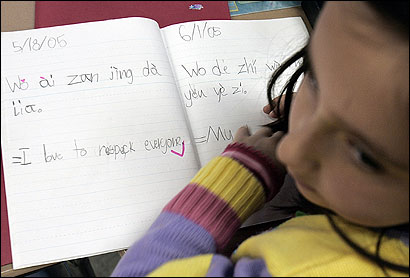
Daria Taubin, 6, a first-grader at the Driscoll School in Brookline, during a Chinese lesson. ‘‘I teach my mom every word I really know,’’ she said.

All first-graders at the Driscoll School can write numbers 1 through 10, name the colors, and talk about plants and the solar system -- in Mandarin Chinese.

They began studying Chinese in kindergarten.

Chinese, a language most school systems don't offer until high school, if at all, is becoming popular in elementary classrooms around Greater Boston, as well as elsewhere in the nation. Spanish still reigns as the most popular language, but parents and lawmakers hope that Chinese soon will become commonly taught. School systems are starting the lessons with the youngest students in hope they learn the language well enough to compete in the new world economy, as China becomes an economic and political superpower.

Continue reading "Along with ABCs, some learn Chinese" »


Hosting by Yahoo!
[ Yahoo! ] options

Foreigners flock to learn Chinese

Indonesian student Ivan Handoyo speaks excellent English, having studied in Australia.

Now the 23-year-old is in Beijing trying to get to grips with Mandarin Chinese.

He wants to study the language so in future he can help his parents with their business selling birds' nests that are used to make soup.

Ivan Handoyo
Ivan Handoyo says he wants to help with his parents' company


"I hope to help the business expand and deal with Chinese people from all over the world," he said.

Thousands of other foreigners are also flocking to China in increasing numbers to learn Mandarin.

Many believe the country's economic boom will continue, and say knowing Chinese is not only interesting in itself but will help them find interesting and lucrative jobs.

In 2004, a record 110,844 students from 178 countries had enrolled at Chinese universities, according to official Chinese newswire Xinhua. That was a 43% increase on 2003.

In addition, more than 30 million people are currently studying Mandarin abroad, the newswire said.

Last July, the government-sponsored first World Chinese Conference was held in Beijing with the aim of promoting Chinese language teaching.

Mavis Li, from the privately-run Beijing Mandarin School, said the sector had been helped by China's entry into the World Trade Organization and the 2008 Beijing Olympics, which had encouraged people to seek lessons on their own, and companies to send their employees to study Mandarin.

"Most of our students come from Europe and North America, but in the last three or four years more are coming from Asia, South America and Africa," she said.

"China is a huge market; foreigners come for business and need to learn Chinese for work. More people are interested in this ancient and modern, marvellous and mysterious country; many believe they can have an adventure here."

To tap into that market, language schools are sprouting up across the capital, their advertisements appearing by the dozen in English-language magazines.

Taiwanese journalist Yu Senlun was recently commissioned by a Barcelona-based international language school to research the possibility of opening a branch in Beijing.

She found that it is a tough market to break into as there is already fierce competition.

Bilingual talent is needed; knowing Chinese will help the learners find a good job
Pang Ming, Beijing Union University

"According to the National Office for Teaching Chinese as a Foreign Language, there are 400 universities in China offering Chinese language classes. The office estimated that in Beijing, there are at least 30 universities and more than 50 private schools."

She said the supply of schools teaching Mandarin exceeds the number of expatriates wanting to learn in Beijing, but she thinks more foreigners can be attracted to the Chinese capital to study.

Many institutions have been waking up to this idea and are recruiting overseas students by holding educational exhibitions abroad and linking up with foreign universities.

Pang Ming, deputy director of the International Programme Department at Beijing Union University (BUU), said her institution had 100 foreign students in September 2000. Four years later, it had 177, and by the autumn of 2005, it had 274.

Of this current batch, 39% came from Indonesia and 31% from South Korea, with the rest from various countries including Japan, Thailand and Britain.

Expanding opportunities

Ms Pang said China's growing business links worldwide were a key reason for the increase in the number of students.

"More countries have launched in China so bilingual talent is needed; knowing Chinese will help the learners find a good job. Some students have learned some Chinese in their own countries, but learning in Beijing is a good language environment and the best way to acknowledge Chinese culture."

Song Juan, a 22-year-old Beijinger, works part-time as a private Mandarin tutor for several foreign students when she is not studying for her degree in computing.

She enjoys teaching so much, and is so convinced the market for Mandarin will continue to grow, that she wants to become a 'proper' teacher after she graduates this year, instead of using her degree to find a job.

"I think I could have a good career teaching Chinese, it would be useful and meaningful," she said. "The whole world wants to understand China; I do not see the craze for Mandarin ending soon."


Hosting by Yahoo!
[ Yahoo! ] options

How hard is it to learn Chinese?

An independent school has become the first in the UK to make

A child carries a toy bear and a flag on Beijing's Tiananmen Square
Mandarin and Cantonese are spoken in China
Mandarin Chinese compulsory for pupils, reflecting the growing importance of China on the world stage. But it's not an easy language to master.

China used to be called a sleeping giant. Now, as the world's fastest growing major economy, it is well and truly awake.

British exports to the country are expected to quadruple by the end of the decade and the government wants every school, college and university to be twinned with an equivalent in China within the next five years.

An estimated 100 schools in the UK are now teaching Mandarin, China's official language, according to the British Council - the UK's international organisation for educational and cultural relations.

Continue reading "How hard is it to learn Chinese?" »


Hosting by Yahoo!
[ Yahoo! ] options