Main | February 2007 »

January 31, 2007

The Basics About Chinese Characters

There are over 80,000 Chinese characters, but most of them are seldom used today. So how many Chinese characters do you need to know? For basic reading and writing of modern Chinese, you only need a few thousands. Here are the coverage rates of the most frequently used Chinese characters:

Most frequently used 1,000 characters: ~90% (Coverage rate)
Most frequently used 2,500 characters: 98.0% (Coverage rate)
Most frequently used 3,500 characters: 99.5% (Coverage rate)

For an English word, the Chinese translation (or the Chinese 'word') often consists of two or more Chinese characters. You should use them together and read them from left to right. If you want to arrange them vertically, the one on the leftmost should go to the top. See an example for the word 'English' below:


As you can see, there are two Chinese characters for English (the language), which are ying1 yu3 in Pinyin. Pinyin is the international standard romanization scheme for Chinese characters, which is useful for learning the phonetics of Mandarin. There are four tones in Pinyin and we use the numbers here, i.e., 1, 2, 3, and 4, to depict the four tones. If you want to learn Mandarin (or Pu3 Tong1 Hua4), you have to master the four tones of the language. However, one pinyin usually represents many Chinese characters. For example, han4 can depict the Chinese characters for sweet, drought, brave, Chinese, etc. Thus you have to learn the Chinese characters to master the language.

Chinese is not alphabetic so the writing is not related to its phonetics. We don't translate the Western alphabet since the letters have no meaning, and we do use the letters in writings, especially in scientific writings.

There are many styles of Chinese writing. Some of the styles are more ancient than others. In general, there are large differences among the styles, even though some of the styles are quite close. Different styles of Chinese characters are naturally used according to the purposes of the writing, such as Xiaozhuan mainly used for seal carving now. Besides the different styles, there are also two forms of Chinese characters, the simplified and the traditional. The simplified is the standard writing form employed in the mainland of China and the traditional form is mainly used in Taiwan and Hong Kong. There are total 2,235 simplified characters contained in the 'Simplified Character Table' published in 1964 by the Chinese government, so the majority of the Chinese characters are the same in the two forms, though the count of commonly-used Chinese characters is only about 3,500.

All the Chinese characters on our site are Kaiti (the standard style) in the simplified form.

Japanese Kanji are originally from China so most of them are the same as their corresponding Chinese characters, but Japanese kanji only contain a small collection of Chinese characters. There are a lot more Chinese characters not included in Japanese Kanji. Kanji are used less and less now in Japan. You don't see a lot of Kanji in a modern Japanese book anymore.


[ Yahoo! ] options

Live in Style

The Fashionable Life of Beijing Youth
The Chinese youth, especially the white collars in big cities like Beijing and Shanghai, now form a fashion of seeking stylish life. To them, grace is something that needs guidance, since it connects with not individuals but social atmosphere. With times' development, the distinction between grace and fashion has been blurred out. Long hair can be graceful, skinniness can be graceful, and acting cool can also be graceful. Grace has actually been nothing but a wish.

The fashionable youth would have their breakfast in McDonald's. Sitting near a window, they can feel the warm sunshine in winter. Young ladies think it worthy to buy those famous brands on sale, and a silk scarf or long socks will add to their femininity. Theaters are an often-visited place since modern operas and ballet are graceful. In the afternoon if they have spare time, Starbark is a good place to enjoy coffee and loneliness. When dining with strangers, they would tell the waiter to bring a glass of water, or of course, it is also a proper choice when they cannot read a French menu. The magazine Fashion is in style, just as their life. But do not read it in subways, or join any activities the magazine holds, for they are out of style. Most of all, do not let others know they buy things under its guidance, which is the least graceful. They would always go shopping in the Xiushui market, even window-shopping sometimes. With the most fashionable wearing and ornaments there, they can be sensitive to the prevailing trends.

As to entertainment, most of them seem to be able to play tennis very well for it is a noble sport. And their favorite TV program is Channel V; it is out of style to stick to long TV series. They prefer their talk mingled with some English words rather than speak English. And the reasons can be explained like this, Eh, this is because...I don't know the word in Chinese...very truebred.

The above is only a picture of the fashionable life of Beijing youth, and some feature stores and bars are introduced here to provide a better understanding for you.

Beijingers refer to Sanlitun Road as the 'Golden Street,' which may have as much to do with the price of real estate as the fact that business is booming there. Sanlitun Road must account for about 75% of the bar-cafes in town. Jazz Ya is an enormous place and one of the busiest nightspots in Beijing. The official address is 18 Sanlitun Rd, although it's actually hidden in a small alley just to the east of the main road. It's open 10:30am to 2am and may be the first bar related with jazz in Beijing. Nearby, Dai Sy's Pub at 48 Sanlitun Rd is a very popular place and has outdoor tables. It opens early and is a good spot for lunch and dinner. Maggie's Bar on Xinyuan Rd is the place to go if you want to stay out all night--operating hours are typically from 6pm to 5am. Among these bars, Loft has an original name. A smart guy didn't translate it as Warehouse in Chinese, but A Coolness-hidden place, which coincides the same Chinese pronunciation with Warehouse. It is designed with a postmodern style; people sit in the open while trees are grown in glass houses. This interesting place can be found at 14 Jianwai Street. Near Beijing University, there is a coffee shop called Carving Time, which is beloved by many college students.

An old bookshelf takes up a whole wall, with the shopkeeper's favorite books, movies, pictures on it. At 17 Dongdaqiao Street in Chaoyang District, there sits a small shop of classic beauty. Several red lanterns are hung from the eaves, and on the old-fashioned door a red silk curtain is put on which embroidered Green Pheonis & Red Dragon, the name of the shop. It is a tailor's shop makes clothes to order. There is a shop called Grass-eater's, which sells products of genuine cattle hide made by hand.


[ Yahoo! ] options

January 30, 2007

Guide Picks - Top 10 Chinese Lucky Symbols

Chinese characters usually have one or more meanings and some of them are particularly loved by Chinese people. Here is the top ten list of the lucky ones. Please note Pinyin is also used here, which is the Chinese spelling system for the characters. For example, fu is the pinyin for good luck in Chinese. But fu is only the phonic part of the character and it also represents other Chinese characters that sound the same.

   1.) Fu - Blessing, Good Fortune, Good Luck
Fu is one of the most popular Chinese characters used in Chinese New Year. It is often posted upside down on the front door of a house or an apartment. The upside down fu means good luck came since the character for upsite down in Chinese sounds the same as the character for came.


 2.) Lu - Prosperity
It used to mean official's salary in feudal China. Fengshui is believed to be the Chinese way to health, wealth and happiness. If you are interested in Fengshui, you may check out the book 'The Feng Shui Kit.'


   3.) Shou - Longevity
Shou also means life, age or birthday.


   4.) Xi - Happiness
Double happiness is usually posted everywhere on Chinese weddings.


 5.) Cai - wealth, money
Chinese often say money can make a ghost turn a millstone. It is to say money really can do a lot of things.


   6.) He - harmonious
'People harmony' is an important part of Chinese culture. When you have harmonious relations with others, things will be a lot easier for you.


 7.) Ai - love, affection
Don't need to say any more about this one. Just want to point out ai is often used with 'mianzi' together. Aimianzi means 'be concerned about one's face-saving.'


 8.) Mei - beautiful, pretty
The United States of American is called Mei Guo in the short form. Guo means country so Meiguo is a good name.


 9.) Ji - lucky, auspicious, propitious
Hope all is well.


 10.) De - virtue, moral
De means virtue, moral, heart, mind, and kindness, etc. It is also used in the name for Germany, i.e., De Guo.

1
[ Yahoo! ] options

MySpace China: What We Know

We’ve known for many months now that MySpace China is set to launch in 2007. In fact, with all the focus on the Chinese roll-out, the launch of MySpace Japan came as a complete surprise. Now the focus is back on the Chinese site, with the WSJ reporting that they’re in talks with International Data Group’s Chinese venture arm and former China Netcom Group CEO Edward Tian regarding the move. Meanwhile, a Chinese source reported this week that Luo Chuan, the former general manager of MSN China, would become the president of MySpace China beginning December 8th. It’s also well-known that Rupert Murdoch’s wife, Wendi Deng, has been involved in the project - it seems she’ll join the board of MySpace China.

MySpace currently reports 80 million unique visitors a month - that’s just 6% of the population of China. With 10% of Chinese people online, News Corp sees the potential for massive growth. What’s more, the stats suggest that MySpace’s growth is finally beginning to slow in the US: it seems they’ve saturated the market, which makes international expansion a priority.

But expanding to China isn’t as simple as rolling out MySpace UK, MySpace Australia, MySpace France and the other international properties that News Corp has launched. For instance, China is considering regulations that would require state permission to broadcast short movies online. There’s also a massive cultural divide. And let’s not forget that BaiduSpace, a blogging platform from China’s most popular search engine, launched recently, and could expand into social networking. There’s still no official deal on MySpace China, but it seems inevitable that we’ll see a launch in 2007.


[ Yahoo! ] options

January 28, 2007

Owner's Vision

I was amazed that more and more people greet me using standard mandarin “Ni Hao” at my work place, Marta station or grocery store when they saw my Asia face.  Definitely Chinese will become a popular language in the world not only because China has 1.3 billion population and 5000 years history but also its economic booming these years.  But where to buy and how to pick up the learning Chinese material always are the questions my friends ask me.  Last year, I need to pick up Chinese textbooks for my school age daughter.  Thanks my parents who taught Chinese for 30 years giving me good advice and helping me contact with bilingual professional to carefully pick up the books for my friends and my daughter.  Now I want to share these books for you who are interested in Chinese language, who are going to travel to China, who will study in China, who are doing business in China or who like Chinese culture.  Thus, with many helps from my family and my friends, I opened this bookstore www.need2learnchinese.com. 


[ Yahoo! ] options

Get Ahead, Learn Mandarin

ILLUSTRATION FOR TIME BY BRIAN STAUFFER

China's economic rise means the world has a new second language—and it isn't English

It's Friday night in Ikebukuro, a Tokyo entertainment district full of cheap bars and pachinko parlors. As the office workers head to their favorite watering holes, three salarymen split from the crowd and enter a decrepit building that stands between a karaoke lounge and a tavern. Ignoring the sounds of sirens, drunken crooning and breaking glass outside, Hidetoshi Seki, Takashi Kudo and Yuji Yano huddle in a tiny room just big enough for a table for four, and open their Chinese textbooks. For the next 50 minutes the trio, all from a small trading company, practice describing their favorite foods and hobbies in Mandarin. Despite their crumpled shirts and five o'clock shadows, they are having a blast. The young female instructor at B-Chinese Language School indulges them as they crack jokes and make fun of each others' muddled pronunciation. Their language classes are the first lessons that any of them have taken since childhood, says Yano, 39. "We sort of unanimously agreed that Chinese would be a useful skill to acquire."

No kidding. The urge that drives those salarymen to pass up karaoke on a Friday night is increasingly common. In the past, when people set out to improve themselves by learning another language, those that didn't already speak it usually picked English. But while English may be the only truly international language, millions of tongues are wagging over what is rapidly becoming the world's other lingua franca: Mandarin. Seen as a key skill for people hitching their futures to China's economic rise, Mandarin is becoming common currency, particularly in Asia where trade ties with the Middle Kingdom are supplanting those of the region's longtime primary partner, the U.S. Indeed, because English is spoken so universally, it no longer offers companies and employees the edge it once did, according to a recent report by British linguist David Gaddol. If you want to get ahead, learn Mandarin. "In many Asian countries, in Europe and the USA, Mandarin has emerged as the new must-have language," Gaddol notes.

To an extent, this is a case of history repeating itself—with a twist. Just as Americans started studying Japanese in droves in the 1980s, when Japan's economy was ascendant, so today, as China rises, the world is embracing Mandarin. (It doesn't hurt that Chinese is spoken by an estimated one out of every six people on earth.) In South Korea, 160,000 high school and university students are studying the Chinese language, an increase of 66% over the past five years. The number of Japanese secondary schools offering Mandarin more than tripled between 1993 and 2005, and in Japan it's now the most taught foreign language after English. Mandarin is even being pushed within China itself, where hundreds of Chinese dialects can make communication tricky. The central government has promoted standard Mandarin, or putonghua, since the 1950s. Growing internal migration has boosted that effort, and putonghua is now commonly heard on the streets of Shanghai and Guangzhou, cities with their own dialects.

Outside Asia, the ranks of students studying Chinese are small but growing rapidly. From 2000-2004, the number of students in England, Wales and Northern Ireland doing Advanced Level exams (those normally taken at age 18) in Chinese climbed by 57%. In the U.S., Chinese still lags far behind traditional foreign languages like French and Spanish, but China is the fastest growing destination for college students studying abroad. "I thought about what I was going to do after I graduated from college," says Kim Ku Jin, a 26-year-old from Pusan, South Korea. "How am I going to earn money? How am I going to eat?" The answer: buckle down and learn Mandarin. When Kim completed his obligatory two-year military service, he headed to the Chinese capital to pursue a language degree at the Beijing Language and Culture University. "In China I will definitely have opportunities," he says. Claudia Ross, a Chinese-language professor at College of the Holy Cross in Worcester, Massachusetts, says she's hearing the same things from her pupils. "Students who enrolled in Chinese used to tell me their parents would say, 'Why on earth are you studying this?'" says Ross. "Now students regularly come in saying, 'I'm taking Chinese because my parents say I should.'" At Holy Cross, enrollment in first-year Chinese doubled last year. "There are dollar signs attached to it," says Ross.

Mandarin was not always so trendy. It's daunting to learn, especially for Westerners, because of the tones used in speech to shift meaning—to say nothing of the thousands of characters that must be memorized to achieve true literacy. Politics threw up another impediment. During the Cold War, when China was sealed off from the rest of the world, fluency in Chinese was considered, at best, an arcane academic pursuit for diplomats and students of acupuncture or Tang poetry. At worst, it was considered the language of the enemy. Despotic right-wing governments in some Asian countries, fearing their regimes would be toppled by the spread of communism, thought of Chinese-speakers as Maoist revolutionary threats. In Indonesia, Suharto banned Chinese-language publications and closed almost all Mandarin schools. But after then President Abdurrahman Wahid lifted the ban in 1999, six universities added Mandarin courses, as did dozens of smaller language centers.

Now, students who can put "fluent in Mandarin" on their résumés are seeing the payoff. Jakarta resident Imam Fanani, 26, was initially discouraged when he began hunting for work last year because many of his friends had been unable to find good-paying jobs. But a day after he submitted his résumé to several employment websites, he had three job offers. His edge? A degree from the University of International Business and Economics in Beijing. "There is no discrimination against the language anymore," says Imam, who now works at a conglomerate owned by an Indonesian Chinese. "In fact, you could even say it's become kind of fashionable."

It's in vogue even in the backwaters of Asia's least developed countries. In 2004, China became Cambodia's biggest foreign investor, and some Cambodians now think Mandarin is as useful as English. The Chea family in Phnom Penh decided to spread its bets: Rotha, a 13-year-old boy, studies English while his 12-year-old sister, Sophea, learns Mandarin. Spending money on language lessons has earned their parents, Chea Song and his wife Sotheary, the ridicule of neighbors, who point out that the Cheas don't have a proper house—they live in their open-air coffee-and-noodle shop. "Some people criticize me, saying I have no home to live in but I send my daughter to learn Chinese," says Chea Song. "But even if I'm poor, I want the best education for my children." English may help his son find a job with one of the many aid agencies working in Cambodia, or allow him to pursue medical studies, Chea reckons. His daughter's Mandarin skills may land her a job in a private business or as a translator. As he sees it, "The whole world is speaking Chinese."


[ Yahoo! ] options

Google's Lookalike is Expanding in China


China's leading search engine, Baidu.com Inc. becomes a news portal as well. This was due to the license that the search portal received from Beijing. Both government and industry sources stated today that the license allows the company, which is also known as "China's Google", to provide news as a fully-fledged news website.

Chinese government source stated that the license, regarding news content service, allows Baidu.com to make its own reports and not simply display results news from other websites.

Government source, being aware of the situation, mentioned that the company has already begun preparing its own news department. However, the spokesperson from Baidu.com did not comment on this.

Due to the 2008 Beijing Olympics run-up, the media and journalist in China may feel somewhat free. The news that can be politically sensitive, however, are still remaining, in a way, censored.

The largest internet portal in China, called Sina.com, received he permission to carry its own reports several years ago, but apart from it, Baidu.com represents the first Chinese search engine to receive this type of license.

Baidu.com is fourth in Alexa's internet rankings. The company has more than a half of market share. The search engine provides an index of more than 740 million web pages, about 80 million images as well as 10 million various multimedia files.

The website's name comes from a poem, called "Song Dynasty", which is constructed in the ci form. The poem was written back in the 12th century by Xin Qiji.


[ Yahoo! ] options

January 26, 2007

Along with ABCs, some learn Chinese

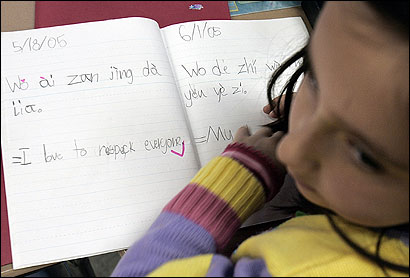
Daria Taubin, 6, a first-grader at the Driscoll School in Brookline, during a Chinese lesson. ‘‘I teach my mom every word I really know,’’ she said.

All first-graders at the Driscoll School can write numbers 1 through 10, name the colors, and talk about plants and the solar system -- in Mandarin Chinese.

They began studying Chinese in kindergarten.

Chinese, a language most school systems don't offer until high school, if at all, is becoming popular in elementary classrooms around Greater Boston, as well as elsewhere in the nation. Spanish still reigns as the most popular language, but parents and lawmakers hope that Chinese soon will become commonly taught. School systems are starting the lessons with the youngest students in hope they learn the language well enough to compete in the new world economy, as China becomes an economic and political superpower.

During the last two to five years, schools in Sharon and Brookline have started elementary Chinese programs. Milton and Needham school systems offer Chinese before or after school. Belmont began offering Chinese instruction to all of its fifth-graders this year. The Carlisle school system is considering adding a pilot program in Chinese for elementary students this fall, and Amherst wants to add Chinese instruction for kindergartners in fall 2006.

The Asia Society in New York City estimates that about 24,000 of the 49.5 million elementary and high school students in the United States are studying Chinese, even though nearly 1.3 billion people speak Chinese in the world; the smallest proportion of US students studying the language are in elementary school. By comparison, more than 1 million students study French, a language spoken by 80 million people worldwide.

''China just is going to be a future power," said Marie Doyle, Carlisle superintendent. ''It behooves us to make sure the children are really studying the culture, the customs, and the language. The more they know, the more successful they will be in the business world."

Educators say early exposure to Chinese is critical. Chinese takes nearly three times as long as Spanish to master, according to the Foreign Service Institute, which trains American diplomats for the State Department. It takes 1,300 hours to achieve proficiency in speaking Chinese, while people need 480 hours to become proficient in French and Spanish.

At the Michael Driscoll School, which began its elementary Chinese program five years ago, about half of the students switch from Chinese to Spanish in the seventh grade. But first-grader Daria Taubin said she plans to continue learning Chinese through high school.

''I want to keep learning, learning, learning and then go to China," said the 6-year-old. ''I teach my mom every word I really know."

Her classmate Ibi Agba, who speaks a Nigerian dialect at home, said Chinese has been hard to learn because some of the sentences are too long to remember. But the 6-year-old said he likes writing pinyin, the English pronunciations of Chinese words, and impressing his parents ''When I speak Chinese to them, they say, 'Wow,' " he said.


[ Yahoo! ] options

Foreigners flock to learn Chinese

Indonesian student Ivan Handoyo speaks excellent English, having studied in Australia.

Now the 23-year-old is in Beijing trying to get to grips with Mandarin Chinese.

He wants to study the language so in future he can help his parents with their business selling birds' nests that are used to make soup.

Ivan Handoyo
Ivan Handoyo says he wants to help with his parents' company


"I hope to help the business expand and deal with Chinese people from all over the world," he said.

Thousands of other foreigners are also flocking to China in increasing numbers to learn Mandarin.

Many believe the country's economic boom will continue, and say knowing Chinese is not only interesting in itself but will help them find interesting and lucrative jobs.

In 2004, a record 110,844 students from 178 countries had enrolled at Chinese universities, according to official Chinese newswire Xinhua. That was a 43% increase on 2003.

In addition, more than 30 million people are currently studying Mandarin abroad, the newswire said.

Last July, the government-sponsored first World Chinese Conference was held in Beijing with the aim of promoting Chinese language teaching.

Mavis Li, from the privately-run Beijing Mandarin School, said the sector had been helped by China's entry into the World Trade Organization and the 2008 Beijing Olympics, which had encouraged people to seek lessons on their own, and companies to send their employees to study Mandarin.

"Most of our students come from Europe and North America, but in the last three or four years more are coming from Asia, South America and Africa," she said.

"China is a huge market; foreigners come for business and need to learn Chinese for work. More people are interested in this ancient and modern, marvellous and mysterious country; many believe they can have an adventure here."

To tap into that market, language schools are sprouting up across the capital, their advertisements appearing by the dozen in English-language magazines.

Taiwanese journalist Yu Senlun was recently commissioned by a Barcelona-based international language school to research the possibility of opening a branch in Beijing.

She found that it is a tough market to break into as there is already fierce competition.

Bilingual talent is needed; knowing Chinese will help the learners find a good job
Pang Ming, Beijing Union University

"According to the National Office for Teaching Chinese as a Foreign Language, there are 400 universities in China offering Chinese language classes. The office estimated that in Beijing, there are at least 30 universities and more than 50 private schools."

She said the supply of schools teaching Mandarin exceeds the number of expatriates wanting to learn in Beijing, but she thinks more foreigners can be attracted to the Chinese capital to study.

Many institutions have been waking up to this idea and are recruiting overseas students by holding educational exhibitions abroad and linking up with foreign universities.

Pang Ming, deputy director of the International Programme Department at Beijing Union University (BUU), said her institution had 100 foreign students in September 2000. Four years later, it had 177, and by the autumn of 2005, it had 274.

Of this current batch, 39% came from Indonesia and 31% from South Korea, with the rest from various countries including Japan, Thailand and Britain.

Expanding opportunities

Ms Pang said China's growing business links worldwide were a key reason for the increase in the number of students.

"More countries have launched in China so bilingual talent is needed; knowing Chinese will help the learners find a good job. Some students have learned some Chinese in their own countries, but learning in Beijing is a good language environment and the best way to acknowledge Chinese culture."

Song Juan, a 22-year-old Beijinger, works part-time as a private Mandarin tutor for several foreign students when she is not studying for her degree in computing.

She enjoys teaching so much, and is so convinced the market for Mandarin will continue to grow, that she wants to become a 'proper' teacher after she graduates this year, instead of using her degree to find a job.

"I think I could have a good career teaching Chinese, it would be useful and meaningful," she said. "The whole world wants to understand China; I do not see the craze for Mandarin ending soon."


[ Yahoo! ] options

How hard is it to learn Chinese?

An independent school has become the first in the UK to make

A child carries a toy bear and a flag on Beijing's Tiananmen Square
Mandarin and Cantonese are spoken in China
Mandarin Chinese compulsory for pupils, reflecting the growing importance of China on the world stage. But it's not an easy language to master.

China used to be called a sleeping giant. Now, as the world's fastest growing major economy, it is well and truly awake.

British exports to the country are expected to quadruple by the end of the decade and the government wants every school, college and university to be twinned with an equivalent in China within the next five years.

An estimated 100 schools in the UK are now teaching Mandarin, China's official language, according to the British Council - the UK's international organisation for educational and cultural relations.

Compulsory

Brighton College, an independent school in East Sussex, this week became the first to make the language compulsory, alongside French, Spanish and Latin.

But it is a tough language to learn for Westerners. There are two main reason for this, says Dr Frances Weightman, a lecturer in Chinese Studies at the University of Leeds.

Firstly, the script poses problems. There is no alphabet, just thousands of characters. There are so many that no one can give a definitive total, but it is believed to be around 60,000.

GETTING THE RIGHT TONE
Tone one - A fairly high, even tone
Tone two - A rising tone, much like the sound at the end of a sentence with a question mark
Tone three - Falls then rises. Like the second, but must dip first
Tone Four - Sharp falling tone, a little like how the end of a sentence with an exclamation mark sounds
Half tone - Pronounce words with light tones in about half the time you would a normal word, without putting emphasis on it

Secondly, the tonal system is hard for Westerners. While the meaning of English words does not change with tone, the same is not true for Mandarin.

Four-and-a-half tones are used, meaning a single word can have many meanings. Ma, for example, can mean mother, horse, hemp, or be a reproach depending on tone. How tones are used also varies extensively from province to province.

"The tonal systems can result in a lot of ambiguity for people learning the language," says Dr Weightman.

Westerners have the reputation of using the fourth tone exclusively for all words. It is a sharp falling sound, a little like how the end of a sentence with an exclamation mark sounds.

Pinyin, a system of transliterating Chinese characters into the Roman alphabet, is used by Westerners to learn basic Mandarin. Things get tougher when students start learning characters, but language experts say a person only needs roughly 5,000 to be literate.

'It's like singing'

One thing that is easier in Mandarin is the grammar.

"The grammar is not nearly as complicated as many European languages," says Dr Weightman. "For example there are no verb tenses, no relative clauses, no singular or plural."

The number of people in the UK learning Mandarin has gone up considerably in recent years, she adds.

"It really appeals to kids, they find the different characters fun and grasp the different tones well, it's like singing for them. The more we demystify the language, the more people will learn it. At the moment it is still seen as exotic and a bit strange, which can put people off. But that's changing."

GCSE entries for the Chinese languages of Mandarin and Cantonese crept up to just under 4,000 last year. Even with its falling popularity, however, the number of entries in French still hit 320,000.

Ann Martin, a Mandarin teacher at the Ashcombe School in Dorking Surrey, believes part of the problem is the exam system, which isn't designed for non native speakers and is hard for them to gain good grades compared to native speakers.

"As far as schools are concerned head teachers are reluctant to timetable Chinese because it is not achievable for non-native speakers," she says.

Business experts are in no doubt about how important Mandarin will become over the next few years.

BBC business reporter Mary Hennock says students speaking fluent English and Chinese are going to be the executives of the future.

"China's economy is growing so quickly and becoming so influential in the world economy that people can't afford to ignore it. People who want to be ahead in whatever industry need to think about China and learning Chinese."


[ Yahoo! ] options

Internet usage in China hits record high

The number of Internet users in China made its highest recorded jump to reach 137 million at the end of 2006, a state information center said Tuesday.

China's Net users grew by 26 million, or 23.4 percent, year over year--the highest jump since the report began in 1997--to reach 10.5 percent of the total population, China Internet Network Information Center said in its 19th Internet development report.

In China, which is close to launching the data-rich third-generation wireless standard--17 million people use their cell phones to go online, and 104 million have broadband Internet access, the report added.

The most popular hobby among young people in China is surfing the Internet, state media reported. China, however, is considered among the harshest Internet censors in the world.


[ Yahoo! ] options

China's Hu calls for tighter 'Net regs

BEIJING - President Hu Jintao has ordered Chinese Internet regulators to promote a "healthy online culture" to protect the government's stability, state media said Thursday. Hu told made the coments to officials at a meeting Tuesday of the Communist Party's ruling Politburo, the Xinhua News Agency and newspapers reported."Whether we can cope with the Internet is a matter that affects the development of socialist culture, the security of information, and the stability of the state," Hu was quoted as saying. The reports gave no details of what steps the government plans to take.But Xinhua quoted Hu as saying the government should "use advanced technologies to better guide public opinions" and "promote online products that can represent the grand Chinese culture." The Chinese government promotes Internet use for education and business but tries, with varying degrees of success, to block its citizens from seeing material it deems subversive or pornographic.

China's online population grew by 23.4 percent last year to 137 million people, about 10 percent of its 1.3 billion population, the China Internet Network Information Center reported earlier this week. The figure puts China on track to surpass the United States in the next two years as the nation with the most Internet users, the government had said.


[ Yahoo! ] options

New count halves China divorces

 
Last Updated: Friday, 26 January 2007, 13:57 GMT
E-mail this to a friend Printable version
A mass wedding in Harbin, China, on 8 January 2007
More Chinese are happy to stay married than previously thought
China has discovered the truth behind its worryingly high divorce rate - a statistical inconsistency.

For years, the country's official divorce rate has been calculated on the basis of the number of people divorced, the China Daily newspaper reports.

Now Chinese statisticians have decided to follow the international practice of counting the number of actual divorces, and seen its divorce rate cut in half.

The 2005 rate fell from 2.76 divorces per 1,000 people to 1.38.

Once rare

The inconsistency came to light thanks to Xu Anqi, a researcher for the Marriage and Family Institute at the Shanghai Academy of Social Sciences.

She had been lobbying various governmental departments of the necessity to correct the problem since the 1990s.

"Based on the wrong statistics, many sensational research reports came out," she was quoted as saying.

With the old calculation, China's divorce rate was higher than that of Japan and South Korea, and close to the US, where the rate is 3.7 divorces per 1,000 people.

Divorce in China used to be rare.

Until 2003, separating couples needed permission from their work unit to divorce, and this was rarely granted.

But economic reforms have brought rapid social change, making divorce more common.

According to the China Daily, 1.6 million people divorced in 2006.

Under the new calculations, that equates to 1.3 divorces for every 1,000 people.


[ Yahoo! ] options

Welcome to our Blog page

We have officially start this page as the platform to provide you with the latest news and updates of everything about chinese learning, chinese culture and chinese world as whole, if you become interested in China and would like to learn more about its language, its people and its culture, and to look for more opportunities for your own benefits, you come to the right place.

As you know, China is the country of 1.3 billion people, Its history dates back to 5000 years ago, and its economy growth is more than twice that of the U.S. People from all over the world, just like you, become interested in this country, they are going there for traveling, for study and for business, a lot of people also find china is the perfect place to live, to work and to develop themselves, for whatever reason you have, learning chinese is your first step toward that goal, learning more about China will certainly help you understand the country better and help you profit from this incredible and rapid growth of the economy, and give you the edge above your peers in this new century. please visit your best online bookstore dedicate to chinese learning at www.need2learnchinese.com


[ Yahoo! ] options

Hosting by Yahoo!